The Library / Crystals
Amethyst
Purple quartz, centuries of lore, and an invitation to pause. A familiar stone with more than one way to be understood.
Reflection · Composure · Inner listening
Overview
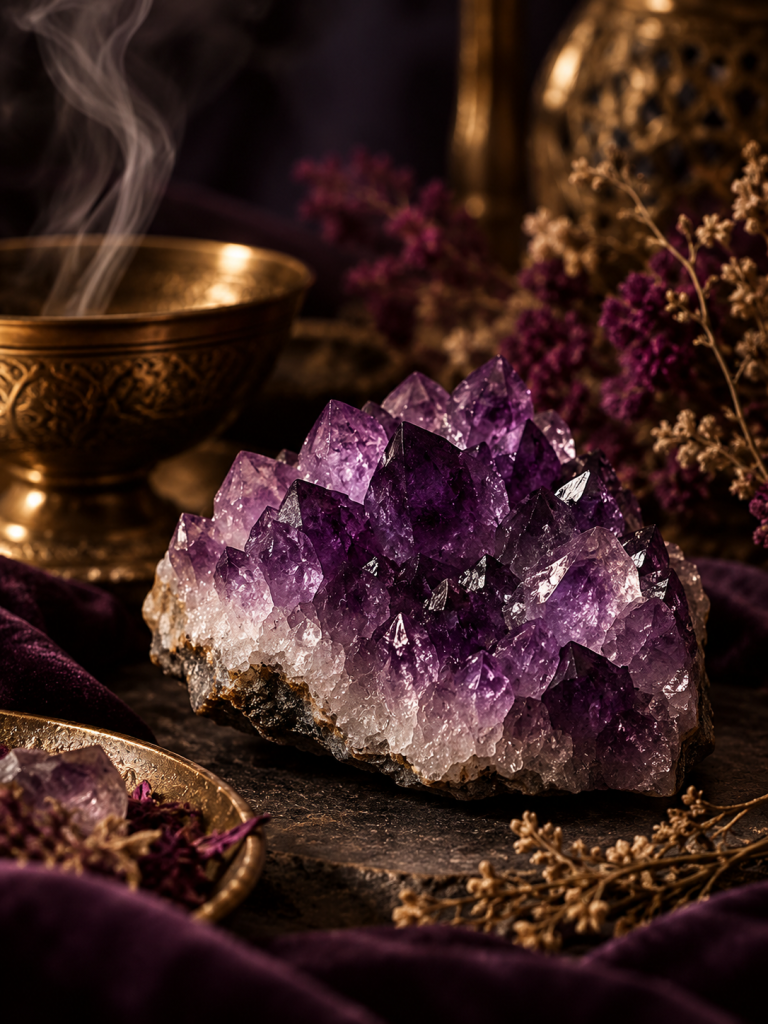
Amethyst is the purple variety of quartz. Its colour can range from delicate lilac to richly saturated purple, with cooler blue or warmer reddish undertones. A single crystal may show distinct zones of lighter and darker colour. Those variations are part of what makes each specimen visually its own.
Symbolism
For a contemporary symbolic practice, amethyst offers a useful starting point for themes of reflection, composure, and inner listening. Its deep purple colour can become a visual cue to slow down, notice your thoughts, or approach a question with greater intention.
These are ways of working with meaning, rather than measurable properties of the mineral. You do not need to adopt a fixed set of correspondences: let the stone’s role in your practice be something you choose.
History & lore
Amethyst’s name comes from the Greek amethystos, associated with the idea of protection against drunkenness. Its wine-like colour helped connect it with Bacchus and stories about remaining clearheaded. These are historical beliefs, not protective effects of the stone.
Today, amethyst is also recognised as February’s birthstone: another layer of meaning that may make it a personal gift or keepsake.
In practice
- Place a specimen beside your journal as a reminder to spend a few undistracted minutes with a question.
- Use it as a visual focus before a tarot reading: name what you want to explore before drawing your cards.
- Include it on an altar or a favourite shelf simply because its colour and form bring you pleasure.
The value of the ritual comes from the attention you bring to it. A beautiful object can be enough.
Care
Amethyst measures 7 on the Mohs hardness scale. Hardness describes resistance to scratching; it does not make a crystal immune to damage. Protect delicate points from knocks, and avoid abrupt temperature changes.
For a suitable, untreated gem, gentle cleaning with warm soapy water is a safe starting point. Avoid steam cleaning and heat. Prolonged intense light may fade some amethyst, so choose a display spot away from strong, sustained sunlight.
Clusters, mounted pieces, and specimens with a matrix may need different care. Check the seller’s guidance before soaking or cleaning them. A symbolic cleansing ritual can be done without water, salt, heat, or direct sun.
Sources & further reading
Mineral facts and historical notes are sourced above. Practice ideas are editorial suggestions from Runic Rose.